My Service Learning Experience
- saveshoestoday
- Apr 24, 2021
- 5 min read
Updated: Jun 8, 2021
Service Learning is great! This semester, I took Professional and Technical Writing with Dr. Darrel Elmore at Florida International University. He incorporates community service into the course materials, an approach known as service learning, and lets students choose the focus of their volunteering. I appreciated this leeway, but it was challenging to think of community service that could be performed safely during the COVID-19 pandemic, when social distancing is a must. I am also an out-of-state student and could not participate in local activities with other students. That said, thanks to the example set by Dr. Elmore and my fellow students, I was was able to find a local opportunity to serve my community in a socially distanced, safe manner. It was awesome!
Philabundance is a non-profit food bank that serves the Greater Philadelphia region. They collect food — more than 24 million pounds each year — and distribute it to people in need. I was happy to be a small part of their efforts. Specifically, I helped organize a food drive with my family and friends. I was surprised at how easy this was to do; I scheduled Zoom meetings with my closest contacts, and they reached out to their network on social media. After a year of social distancing, everyone was clamoring to feel connected and make a difference in the community! In the end, we collected more than fifty pounds of high-priority food items like peanut butter, canned chili, and trail mix and dropped it off with a local agency recommended by Philabundance. It felt great!
After this experience, I am convinced that service learning is one of the best ways to approach education. Not only does it benefit the community, but it benefits the students as well. In fact, in "The Impact of Community Service Learning on the Social Skills of Students," a scholarly article published by the Journal of Education and Educational Development, it was found that "community service learning increases . . . social skills as well as a sense of responsibility" and "should be part of school curriculum." I agree wholeheartedly! I cannot stress enough how great it felt to be social again, even if socially distanced, while contributing something meaningful to my community. I am thankful for service learning and will advocate for it every chance I get!
Before organizing the food drive, I came across an article titled "A Rights-Based Approach to Food Insecurity in the United States" by Dr. Mariana Chilton and Dr. Donald Rose in the American Journal of Public Health. Published in July 2009, approximately 12 years ago, the article is still relevant today. Read the full article here: www.ncbi.nlm.nih.gov/pmc/articles/PMC2696644.
To summarize, the article advocates that the United States government treat food as a human right. This means that the government would have an obligation to end food insecurity. Currently, the right to food is not an enforceable obligation but the article makes a convincing case that it should be. The authors conclude that the rights framework will "advance the US government's leadership in improving the well-being of its vulnerable populations." It's hard to argue with that.
The intended audience for the article is research, policy analysis, advocacy, or education experts. As such, the authors use technical language and academic jargon. The rhetoric is as follows:
Ethos:
Dr. Mariana Chilton is a professor of public health at Drexel University. She is the director of the Center for Hunger-Free Communities and co-principal investigator of Children's HealthWatch. She advised Congress and the United States Department of Agriculture as co-chair of the National Commission on Hunger. Dr. Chilton has a PhD from the University of Pennsylvania, MPH from the University of Oklahoma, and BA from Harvard University.
Dr. Donald Rose is a professor of nutrition at Tulane University. He acted as a consultant to the United Nation's Food and Agriculture Organization and World Food Programme. He served the United States Department of Agriculture’s Economic Research Service on domestic food assistance policy and in Mozambique and South Africa on food security and nutrition. Dr. Rose has a PhD, MPH, and BS from the University of California, Berkeley.
Pathos:
The authors make an emotional appeal that hunger in a wealthy country like the United States is especially unjust, saying that "The existence of widespread food insecurity in a country with the world's largest economy—one that produces a cornucopia of food even to the point of grand-scale exports of surplus commodities—is morally reprehensible."
On a related note, the article suggests a values-based mode of persuasion as a means to achieve its aim: "Dominant US cultural beliefs express strong values for ways that the US system unleashes the spirit, energies, and ingenuities of the individual. . . . By convincing others that the right to food is about creating enabling environments and conditions for people to feed themselves; by insisting that nutritious food is not simply a basic need, but a fundamental human right; and by having a clear and convincing definition of food insecurity and hunger, it will be possible to advance a human rights approach."
Logos:
The authors use reams of data to make logical arguments that support their case. Notably, they state that food insecurity affects 11.1% of the population, 30.2% of female-headed households, and more than 12.4 million children and that attempts to reduce hunger rates outside of a human-rights framework have failed to have a sizable impact.
The article also makes a logical argument for its proposal on the basis of economics: "With more than 12 million children living in households that are food insecure, sizable segments of the population are at risk for poor development and impaired performance in school, an outcome that can diminish national productivity. Food insecurity costs about $90 billion per year in increased medical care costs, lost educational attainment and worker productivity, and investment burden into the emergency food system."
Hunger is a serious problem, and I am glad there are experts and non-profit organizations working to solve it. I've had bouts of hunger myself, but never the debilitating kind that afflicts so many of our neighbors in the United States. I can't help but think of the advantages I've had by not facing serious long-term hunger. According to Philabundance: "It affects everything — from health to education to financial success. It is hard to concentrate on school work, find a job, or manage a heart problem if you struggle with food insecurity." From my limited experience, this is true; when I'm hungry, it's hard to focus on much else. I am lucky to not have been held back by this, and I feel compelled to help others reach their full potential with full bellies too.
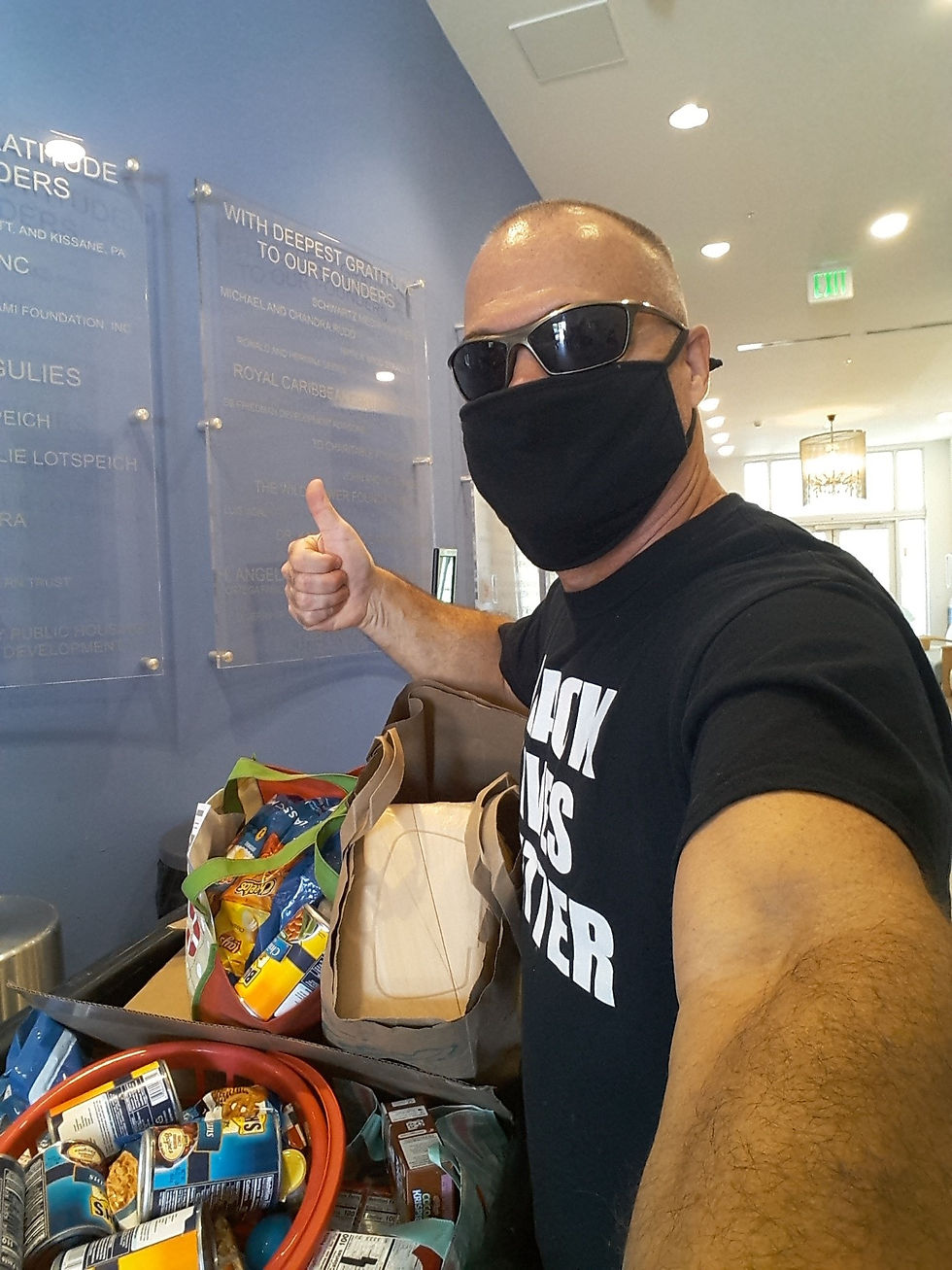
Dr. Darrel Elmore collects food for Lotus House Shelter in Miami, Florida, in spring 2021. He and local participating students were the inspiration for my service learning project in Philadelphia.

My humble contribution to a local food bank in spring 2021. Service learning is the best!
Comments